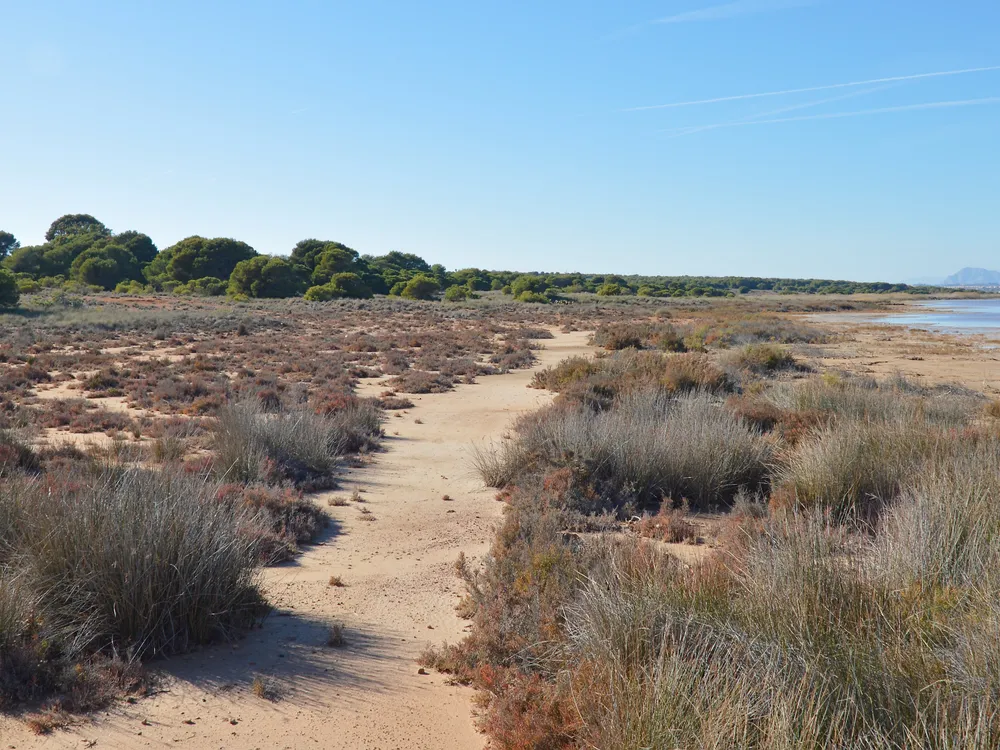
Parque Natural de las Lagunas de La Mata y Torrevieja (Laguna Rosa)
A 3,743-hectare natural park with two large salt lagoons: the Torrevieja one, an astonishing pink colour caused by the microscopic alga Dunaliella salina, and the green La Mata lagoon. It is one of the Valencian Community's most important wetlands, home to flamingos and thousands of water birds, and to working saltworks among the most productive in Europe.
The colour is the first thing that surprises you: the Torrevieja lagoon turns pink because of a microscopic alga, Dunaliella salina, which pigments the salt water. It is part of the Lagunas de La Mata y Torrevieja Natural Park, 3,743 hectares of protected wetland in Torrevieja that bring together two very different lagoons: the pink Torrevieja one and the green La Mata one.
What to see
This is one of the Valencian Community's most important wetlands. Flamingos and thousands of water birds gather along the shores, especially during the migration seasons. The saltworks are still operating and rank among the most productive in Europe, so you'll see the wide evaporation pans and white salt mounds beside the tinted water.
For your visit
- The pink is strongest in summer and in mid-afternoon, with sun and little wind.
- There are signposted trails and viewpoints; bring water and a hat, as shade is scarce.
- Swimming in the salt lagoon is not allowed because of its natural value.
A few minutes south lies Cala Ferris, another clean-water stop to round off the day.
Frequently asked questions
Is there a charge to enter the La Mata and Torrevieja Lagoons Natural Park?
No, it's a natural area with free access. It covers 3,743 hectares with two large salt lagoons: the pink one of Torrevieja and the green one of La Mata.
Why is the Torrevieja lagoon pink?
The pink colour comes from a microscopic alga, Dunaliella salina, which pigments the lagoon's salt water.
What can you see at the lagoons?
It's one of the most important wetlands in the Valencian Community: flamingos and thousands of water birds, especially during migration, plus working salt pans among the most productive in Europe.
Also nearby
You might also like
Parque Natural de las Lagunas de La Mata y Torrevieja (Laguna Rosa) has a fuller guide on our sister site, dedicated to Alicante province.See it on FindeAlicante →
Comments
Sign in with Google to comment and rate
What did you think? Be the first to share it.