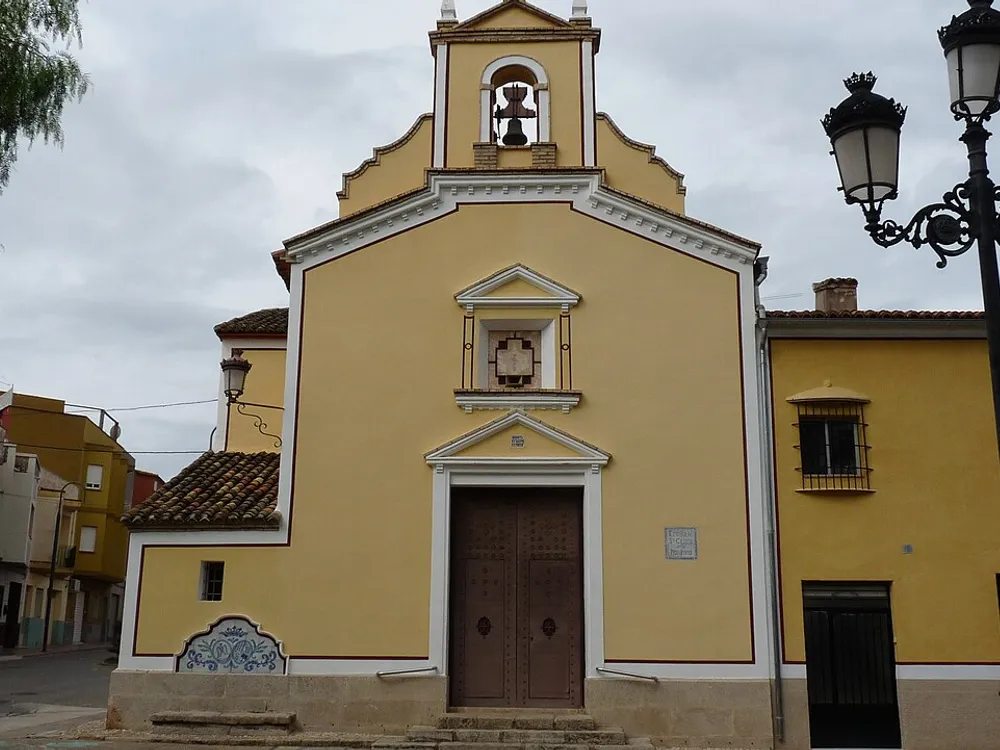
Ermita del Santísimo Cristo de la Providencia
It was built from 1749 after the earthquake that damaged the parish church in Anna, when townsfolk sought safety in the upper part of the village. It is a Latin-cross building crowned by a dome, with a Neoclassical façade and a Valencian sundial on its side bearing verses to Christ. It holds two embossed copper pieces and paintings inspired by Raphael and Rubens, while at its foot El Calvario was raised with public donations. It is listed as a Site of Local Relevance (Bien de Relevancia Local).
In the upper part of Anna, in the Las Eras neighbourhood, stands the Hermitage of the Holy Christ of Providence. It was born from a moment of adversity and today it is still valued by locals, listed as a Site of Local Relevance.
History
Construction began from 1749, after an earthquake damaged the parish church and the villagers sought refuge in the upper part of the town. Popular devotion drove the work forward and, in time, El Calvario (the Calvary) was raised at its foot thanks to donations from the locals, a sign of how deeply rooted this chapel is in village life.
What to see
The building follows a Latin-cross plan crowned by a dome, with a plain neoclassical façade. On one side stands a Valencian sundial, with verses dedicated to the Christ. Inside, two pieces of embossed copper are preserved, along with paintings of classical inspiration, in the tradition of masters such as Raphael and Rubens.
Tips for your visit
- Pair your visit with a walk through the upper part of Anna and its traditional streets.
- Look for the sundial on the side wall and the verses that accompany it.
- Check opening times, which may depend on local worship.
Frequently asked questions
Does it cost anything to enter the Hermitage of the Holy Christ of Providence?
No, entry is free. It is listed as an Asset of Local Relevance and is regarded as one of the most beautiful hermitages in the Valencia region.
Why was this hermitage built?
Construction began from 1749, after the 1748 earthquake damaged the parish church and villagers sought refuge in the upper part of the village.
What can you see there?
It has a Latin-cross plan crowned by a dome, a Neoclassical façade and a Valencian sundial with verses to Christ. It holds two embossed copper pieces and paintings inspired by Raphael and Rubens, with El Calvario at its foot.
Comments
Sign in with Google to comment and rate
What did you think? Be the first to share it.