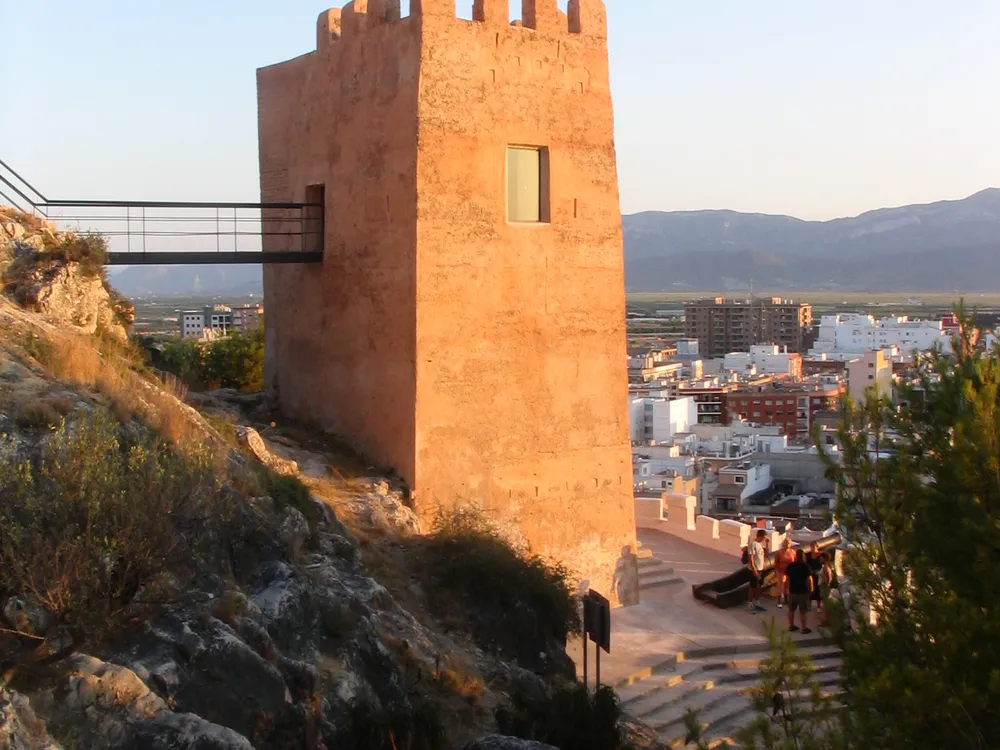
Torre de la Reina Mora (Torre de Santa Ana)
A 13th-century Islamic tower with a square plan and truncated-cone shape, on the castle-hill slope facing the Barri del Pou; it was part of the fortress's defensive system and the gateway to its second walled enclosure. Abandoned militarily, in 1631 it was turned into a hermitage —first dedicated to Saint Raphael and later to Saint Anne, from which it takes its name— and today stands restored as a landmark of the old town.
Square in plan and shaped like a truncated cone, the Torre de la Reina Mora is a 13th-century Islamic tower set into the castle-hill slope, right opposite the Barri del Pou in Cullera. It served as the gateway to the fortress's second walled enclosure.
From tower to hermitage
Once it lost its military role, in 1631 it was converted into a hermitage: first dedicated to Saint Raphael and later to Saint Anne, which gives it its other name, Torre de Santa Ana. The local legend of a Moorish queen eventually took over in everyday speech.
What to see nearby
Restored, it is one of the landmarks of the old town and a good place to understand how the town was defended. From here the climb to the castle takes only a few minutes, so it's worth linking both visits on the same walk through upper Cullera.
Frequently asked questions
Can you see the Tower of the Moorish Queen for free?
Yes, it is one of the landmarks of Cullera's old town that you can view freely.
Where is the Tower of the Moorish Queen?
It sits on the slope of the castle hill, right in front of the Barri del Pou, in Cullera, about 45 km from València.
Why is it called the Tower of Santa Ana?
It is a 13th-century Islamic tower that in 1631, no longer in military use, was fitted out as a hermitage dedicated first to Saint Raphael and then to Saint Anne, which gives it that name.
Comments
Sign in with Google to comment and rate
What did you think? Be the first to share it.