Església de Sant Roc
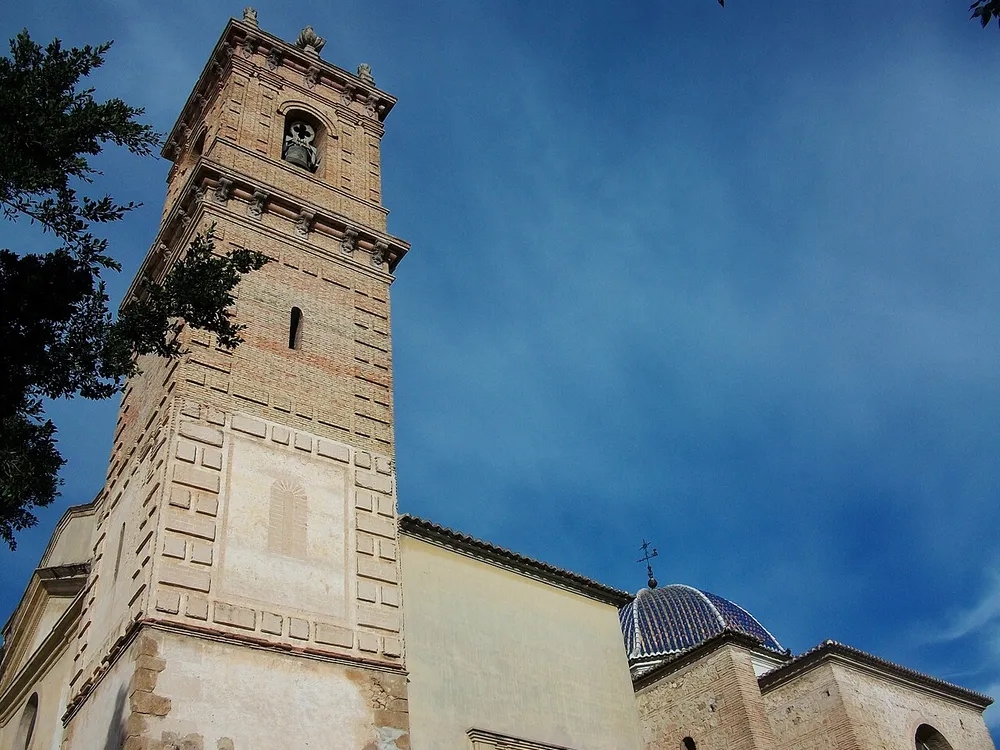
Raised on the foundations of a former mosque that was turned into a Christian temple when the parish was founded in 1535, the present building was completed in 1886. With a sober Neoclassical facade crowned by a triangular pediment, it has a Latin-cross plan, a barrel vault and striking polychrome domes clad in glazed ceramic. The pendentives of the central dome preserve paintings of the Evangelists by the artist Antonio Cortina.
In the very heart of the old town of Oliva, the Església de Sant Roc is one of those churches where the history of the town is written into its own stones. Built on the foundations of a former mosque that was converted into a Christian temple when the parish was created in 1535, the building we see today reflects centuries of change, reaching its present form when it was completed in 1886.
History
The parish dates back to 1535, when the original Islamic place of worship was adapted to Christian use. The church grew and was reformed over the following centuries, and was not finished until 1886, which explains the sober, mature character of the whole. It is a story typical of the towns of this region, where the medieval and the modern coexist within the same walls.
What to see
The neoclassical façade, crowned by a triangular pediment, gives way to an interior with a Latin-cross plan covered by a barrel vault. The most striking feature is its polychrome domes of glazed ceramic, which gleam under the Mediterranean sun. On the pendentives of the central dome you can still see the paintings of the evangelists by the artist Antonio Cortina.
- Note the contrast between the plain façade and the colourful domes.
- Look for the four evangelists on the central pendentives.
- Pair your visit with a stroll through the rest of Oliva's old town.
Frequently asked questions
Does it cost anything to visit Oliva's Església de Sant Roc?
No, entry is free.
Where is the Església de Sant Roc?
Right in the heart of Oliva's old town.
What makes the Església de Sant Roc special?
Built over a former mosque when the parish was created in 1535 and finished in 1886, it has a Neoclassical façade, a Latin-cross plan, polychrome tiled domes and paintings of the evangelists by Antonio Cortina.
Comments
Sign in with Google to comment and rate
What did you think? Be the first to share it.